Christmas Concert | Cyngerdd Nadolig
Monday 1 December | Dydd Llun 1 Rhagfyr 2025
7:30pm | 7.30yh
St David’s Church, Neath, SA11 3AA
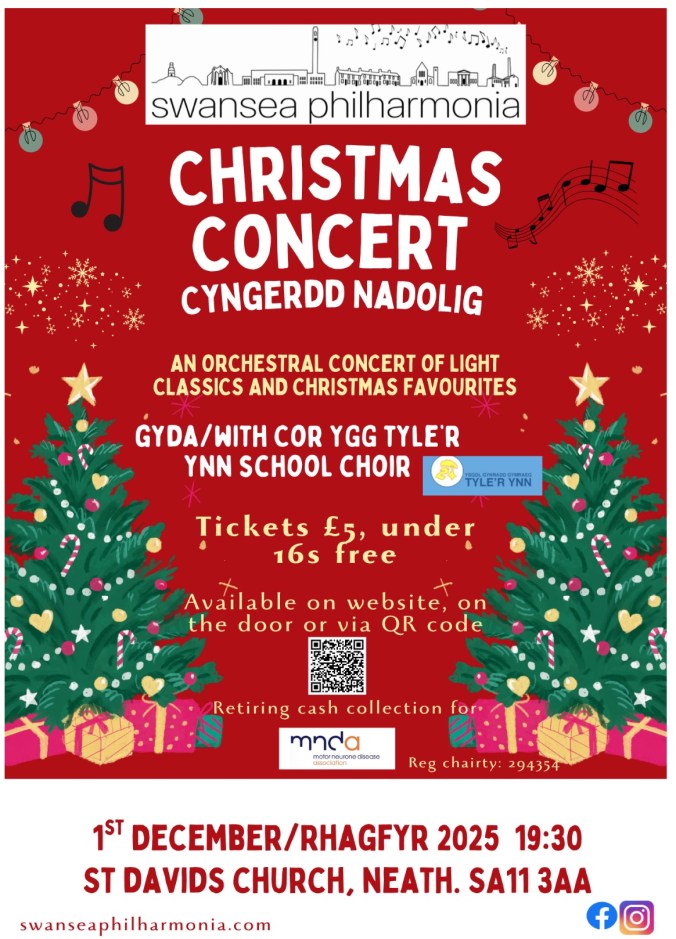
Special Guests: Cor YGG Tyle’r Ynn


Collection in aid of Motor Neurone Disease Association
Registered Charity No. 294354
Programme
Delibes, Mazurka and Czardas from the ballet Coppelia
Arturo Márquez, Conga del Fuego Nuevo
Ysgol Gynradd Gymraeg Tyle’r Ynn School Choir
Edward German, Welsh Rhapsody
INTERVAL
Carol Come All Ye Faithful
Christmas at the Movies
Jingle Bells
Ysgol Gynradd Gymraeg Tyle’r Ynn School Choir
Leroy Anderson, Sleigh Ride, Christmas Festival Overture
Carol Hark the Herald Angels Sing
Programme Notes
Leo Delibes (1836 – 1891) Mazurka and Czardas from the ballet Coppelia
Delibes was taught music by his mother and uncle and went on to study at the Paris Conservatoire. After leaving he went on to work in the theatre, and by 1863 he was having his works performed at the Theatre-Lyrique.
Delibes was a truly great ballet composer who influenced Tchaikovsky and Stravinsky. Coppelia was a groundbreaking ballet which premiered in Paris on 25th May 1870. His melodies were more lyrical than past compositions for the ballet, and his use of the leitmotiv (character themes) was more extensive and advanced. The nationalistic melodies and dances were not only prominent but also authentic. This was the first use of the Hungarian czardas, a very complex national dance, in a ballet. A czardas is the national dance of Hungary, musically it is characterised by a slow expressive melancholy section which gives way to a fast lively energetic section. It is thought to have originated as a “death dance” performed by victorious soldiers after having defeated their enemies. A mazurka is an energetic Polish folk dance in triple meter with accents on the second or third beat of the bar. The czardas and mazurka dances in Coppelia were the culmination of folk dances in the Romantic ballet and a sign of things to come. The artistic cohesiveness of the work with its incorporation of national dances, technical virtuosity and divertissements were all a foreshadowing of the Classical ballet that we know today.
Coppelia is ballet’s great comedy, it ran for three months before the Franco-Prussian War and the siege of Paris closed it down, ending French domination of ballet forever.
Arturo Márquez (1959- ) Conga del Fuego Nuevo
Márquez is a native of the Mexican state of Sonora, Márquez is known for incorporating Mexican musical forms and styles into his compositions. He is one of Mexico’s eminent contemporary composers, and is widely popular with Latin Americans for the accessibility and attractiveness of his compositions. Educated at the Conservatorio Nacional in Mexico, he went on to graduate study in California and Paris. His father was a traditional mariachi musician, but early on, Arturo chose to compose in the latest, modern styles, often in the usual dissonant and obscure manner. However, he later gravitated to a personal idiom that made full use of traditional Mexican urban music—but not necessarily “folk” music.
“Conga” variously refers to groups of musicians, to a kind of drum, and to a specific dance, as well. All are popular in Latin-American countries, most especially in the street carnivals of Havana and Santiago de Cuba. These musical groups are part of the camparsas that parade down the streets in jubilant, often riotous carnival celebrations. The term, “conga” has a long and somewhat ambiguous history, but it certainly stems from the belief that the dance, itself, was taken to Cuba by black slaves from the West Indies.
The dance is characterized by a strong pulse on the beat for three beats, followed by a syncopated “thump” just before the fourth beat. Márquez has taken this dance and infused it with new life in a sophisticated symphonic guise. Lyrical melodies seem to “float” above the welter of syncopated rhythms produced by the percussion.
Edward German (1862 – 1936) Welsh Rhapsody.
Sir Edward German, rose to prominence in Great Britain during the last decade of the 19th century as a composer of orchestral music. He was regarded as the natural heir to Arthur Sullivan, and his best period came after Sullivan’s death. He gained a reputation as a composer in the traditional country music style. Early on he gave up conducting to work solely as a professional composer, fulfilling prestigious commissions from festivals and theatrical producers.
Born in Whitchurch Shropshire, he was christened German Edward Jones, German being an anglicisation of the Welsh name Garmon – indicative of his Welsh ancestry. German’s musical talents led him to the Royal Academy of Music in 1880. (It was there that he adopted his professional name, seemingly to avoid being confused with another Edward Jones.) Initially he studied organ and violin as his principal study, but his interest was drawn increasingly towards composition which he studied, sharing tutorial sessions with his friend Henry Wood.
German wrote numerous compositions for theatre productions making him well known and much in demand in the decades spanning the 19th and 20th centuries. When his compositional output diminished, German remained active as a conductor of his own music until poor health and eyesight forced his retirement in the late 1920s. Much respected as a conductor, he gave up performing works by others to specialise in directing his own music.
Welsh Rhapsody
The Welsh Rhapsody is probably the most performed, nowadays, of German’s extended orchestral works. It was written for the 1904 Cardiff Musical Festival where it made an overwhelming impression at its premiere. At first German had difficulty in deciding how best to fulfil the Cardiff commission and rejected various possibilities, including a Shakespearean Suite, before hitting upon the idea he was to pursue. His first biographer, W.H. Scott, recalled the moment of inspiration:
‘One morning, musing over a pipe of tobacco after breakfast, the thought suddenly flashed across him: “Why not something of a purely Welsh character? And what more appropriate than a Welsh Rhapsody?”’
Using some volumes of Welsh melodies, German set about selecting the traditional tunes that he was to fashion into the rhapsody. The work is, however, more than a sequence of arrangements. German managed to use the traditional material as the basis for a work that is stylistically very much his own. This he did not so much by incorporating original material but through his distinctive treatments of the Welsh tunes themselves. The work’s four sections, played without a break, correspond in character to the movements of a symphony; but it is the genuinely symphonic handling of the material that makes its description as a miniature symphony apt.
Each section is numbered in the score and headed with the familiar English titles of the tunes as follows:
I. Loudly Proclaim
II. Hunting the Hare – Bells of Aberdovey
III. David of the White Rock
IV. Men of Harlech
The first section is a ternary structure based on the stately processional strains of Ymadawiad y Brenin (‘The Departure of the King’), with a central episode in which fragments of the traditional melody are developed amidst German’s own contrasting secondary ideas. The second section provides the scherzo with its transformation of the spritely Hela’r Ysgyfarnog (‘Hunting the Hare’) into a sparkling tarantella – one of German’s favourite dances. Its pervasive rhythms continue as a background to the new theme, Clychau Aberdyfi (‘The Bells of Aberdovey’), which is introduced in the trio-cum-development episode. The words tell of the ringing bells of Cantre’r Gwaelod, the legendary lost lands submerged beneath the waters of Cardigan Bay.
One of the loveliest of Welsh melodies, Dafydd y Garreg Wen (‘David of the White Rock’), provides the material for the slow movement. Here again the composer creates a central section in which fragments of the principal theme are freely treated and explored. German came to feel a particular affection for this tune which he requested to have played at his funeral.
The finale begins with a distant march rhythm, increasing in volume as if moving closer, first with fragments of the theme heard between ominous rhythmic reminders of the opening movement on horns and trumpets, only to recede and begin a second advance that finally culminates in the triumphant arrival of the Men of Harlech to their famous march, Rhyfelgyrch Gwyr Harlech (‘The Advance of the Men of Harlech’). The consummate skill with which melodic snatches are tossed about the orchestra brings to mind the famous march in Tchaikovsky’s Symphonie Pathétique, but the obvious parallel the movement draws is with the Rákóczy March from Berlioz’s La Damnation de Faust. Comparisons aside, however, the finale succeeds on its own terms as an outstanding example of its genre, a masterly climax to a brilliant orchestral showpiece.
Extremely popular in German’s lifetime, the Welsh Rhapsody was the last orchestral composition of his own that German conducted in public – fittingly at Aberystwyth in 1927. He described the reception on that occasion as ‘tremendous’. Nearly 70 years later, at a concert held in the same town to celebrate the 125th anniversary of the University College of Wales, the work was still capable of raising an audience to its feet – a response not accounted for simply by its special appeal to a Welsh audience.
Leroy Anderson (1908 – 1975) Sleigh Ride & Christmas Festival Overture
Leroy Anderson is one of the most well- known and popular American composers. He attended and later worked at Harvard University where he directed the Harvard University Band. After World War 2 he became a principal arranger for the Boston Pops, an orchestra for which he also wrote a series of short original compositions often with picturesque titles. In 1945 he wrote Syncopated Clock which is the tune which shot him to fame, when it was selected as the theme song for The Late Show and his fame was soon consolidated when his recording of Blue Tango sold over a million copies. By 1953 he had been named as the American composer most frequently played by American orchestras. He continued composing and arranging right up to 1974. Notable examples of compositions or arrangements from his early work include Annie Get Your Gun 1947; Buttons and Bows 1947; South Pacific 1950.
Anderson’s catchy style raised the prominence of the popular orchestral miniature, but his work also coincided with the rapid expansion in the ownership of radio and television which made his work familiar to millions of listeners in America and beyond, to the extent that many would know his tunes, even though possibly they would not have been able to have named Leroy as the composer or arranger.
Anderson was distinguished by careful workmanship and an ingratiating humour. His music was heavily influenced by Gershwin, and other popular song composers. His orchestrations are vivid using for example the whip and sleigh bells in Sleigh Ride, The Christmas Festival was one of his early arrangements published in 1950, and begins with Joy to the World and ends with Jingle Bells and O Come All Ye Faithful.
 Swansea Philharmonia